
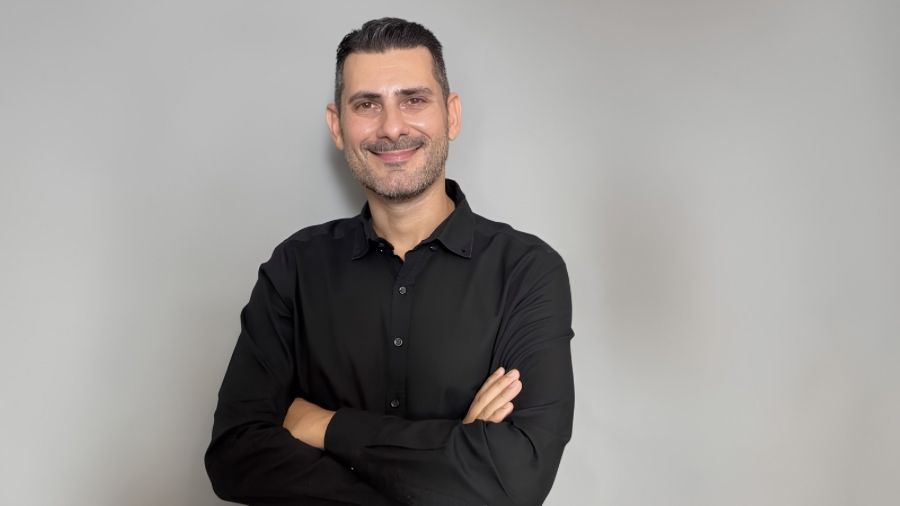
A significant milestone for the University of Thessaly and the Greek academic community was marked today with the successful public defence of the doctoral dissertation of Christos Georgokostopoulos, who becomes the first hearing impared doctoral graduate in Social Sciences and Humanities in Greece
Professor Chrysi Laspidou, Vice Rector of Innovation, Internationalization, Collaborations and Digital Governance at the University of Thessaly, attended the defence and addressed the academic community on behalf of the University’s Administration.
For Professor Laspidou, the significance of this achievement extends far beyond the completion of a doctoral degree. It represents an important step towards a more inclusive academic environment—one in which equal access to education is accompanied by equal participation in the production of knowledge.
“Real inclusion in academic life goes beyond access to knowledge. It is completed when everyone can participate equally in the creation of knowledge.”
The academic journey of Christos Georgokostopoulos illustrates this transition in a powerful way: from a hearing impaired student and recipient of education to a researcher producing new scientific knowledge, perspectives, and methodologies.
His achievement also raises an important dimension of the way we understand innovation within universities. Innovation is not limited to technological advances. It also involves the ability to rethink academic, digital, and research processes so that the talent, knowledge, and different experiences of every member of the academic community can be fully recognised and supported.
The University of Thessaly places inclusion, accessibility, and equal participation at the heart of its commitment to a modern and open university. The support provided throughout Christos Georgokostopoulos’s academic journey, including the contribution of the Unit for Equal Access of the University of Thessaly, demonstrates the importance of creating the conditions in which every student and researcher can fulfil their potential.
Professor Laspidou expressed her warm congratulations to Christos Georgokostopoulos, his supervisor Professor Galini Sapountzaki, and everyone who contributed to his academic journey, with particular recognition of the Unit for Equal Access for its important support.
The successful defence is both a remarkable individual achievement and an important moment for the wider academic community. It demonstrates what becomes possible when universities actively remove barriers and create meaningful opportunities for participation.
The University of Thessaly looks forward to seeing this milestone become part of a broader transformation towards a university where diversity is recognised as a source of knowledge, innovation, and strength—and where many more such academic journeys can follow.